
What Is Actually Happening Inside My Body? PCOS Explained (Finally)
You know the feeling.
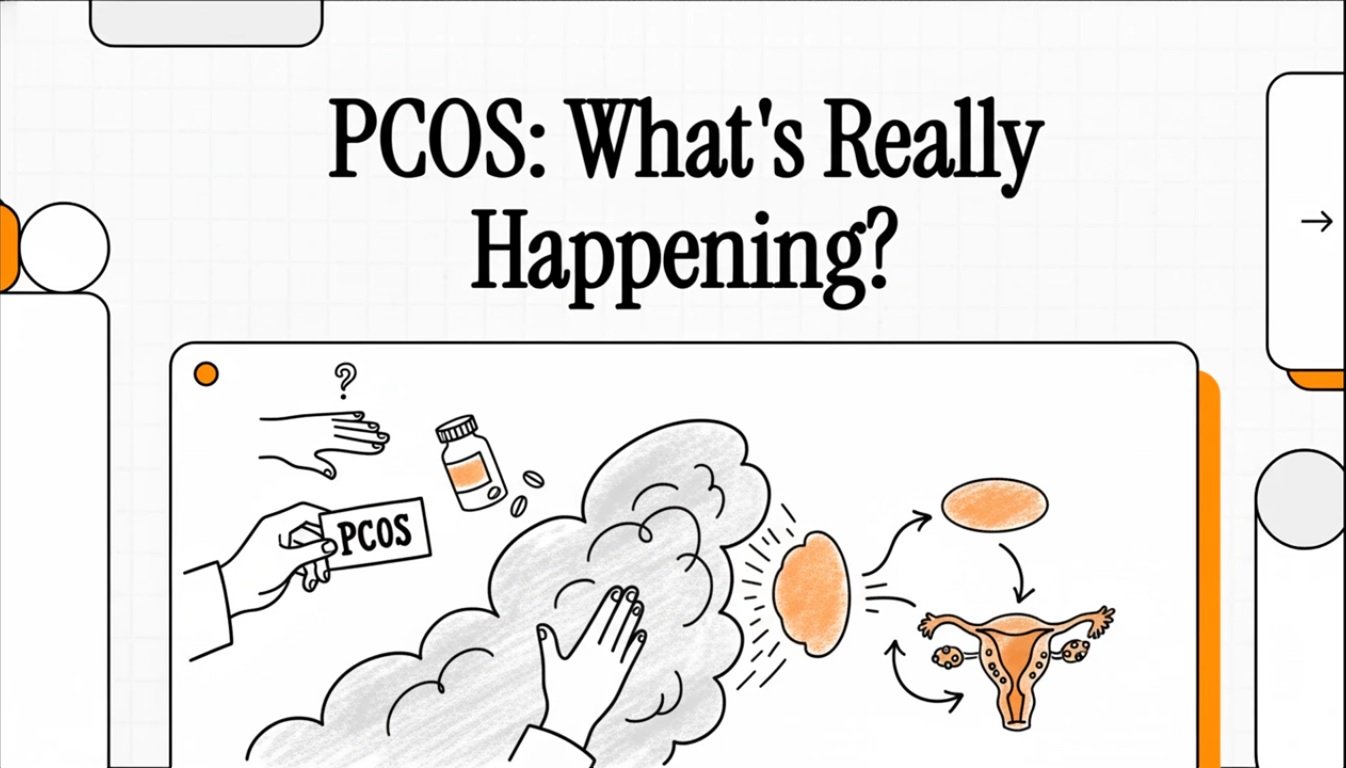
You’re sitting in the doctor’s office. You’ve probably been feeling “off” for a while—maybe your period is missing, you’re feeling tired all the time, or your skin is acting up. The doctor looks at a chart or an ultrasound and says four letters: PCOS.
They might tell you it stands for Polycystic Ovary Syndrome. They might hand you a prescription for birth control and say, “Come back when you want to get pregnant.“
And then you walk out the door, sitting in your car with a million questions. Do I have cysts? Is something wrong with my ovaries? Why is this happening?
If that sounds familiar, take a deep breath. You are not alone, and you are not broken. To truly manage PCOS, you have to understand it. So, let’s move past the confusing medical talk and look at what is actually happening inside your body.
1. It’s a “Syndrome” Not a Disease
First, let’s clear up the name. A “disease” usually has a specific cause and a specific cure (like the flu). A syndrome is different; it is a collection of symptoms that tend to show up together.
Because it’s a syndrome, it looks different on everyone. You might have acne but regular periods. Your friend might have irregular periods but clear skin. You both still have PCOS.
So, how do doctors know you have it? They use “The Rule of 3” (medically known as the Rotterdam Criteria). To be diagnosed, you usually need 2 out of these 3 things:
- Irregular Periods: Your ovaries aren’t releasing an egg on a schedule.
- High Androgens: High levels of “male” hormones (shown in blood work or physical signs like acne/facial hair).
- Polycystic Ovaries: Visible on an ultrasound.
2. The “Cyst” Myth: They Aren’t Actually Cysts
This is the part that scares people the most. When we hear “cyst, ” we think of abnormal growths that need to be removed.But in PCOS, these aren’t dangerous cysts. They are actually immature follicles.
Think of it like a traffic jam:
- Every month, your ovaries try to grow a group of follicles (which hold your eggs).
- Usually, one “winner” grows big enough to be released (ovulation).
- In PCOS, the hormones needed to pick a winner are unbalanced.
So, the follicles start to grow, but they stall out halfway. They never cross the finish line.
They just sit there, waiting. On an ultrasound, these stalled follicles look like a “string of pearls.” They aren’t harmful, but they are a sign that ovulation didn’t happen.
3. The “Hormone Cast”: Who is Causing the Trouble?
PCOS is not really a reproductive problem; it is an Endocrine (Hormonal) condition. Your ovaries are doing exactly what they are told—the problem is that the messengers (hormones) are sending mixed signals.
Here are the main characters causing the static:
The Instigator: Insulin
You might wonder what blood sugar has to do with your ovaries.
The answer is: Everything.
Insulin is the key that unlocks your cells to let energy (food) in. In many women with PCOS, the lock is rusty (this is called Insulin Resistance). Because the key doesn’t work well, your body panics and pumps out more insulin. Here is the catch: High levels of insulin tell your ovaries to produce more Testosterone. This is the direct link between what you eat and your hormones. Getty Images The Disruptor: Androgens (Testosterone)
Every woman has male hormones they are essential for mood and bone strength! But in PCOS, the volume is turned up too high.
When Androgens are too high, they shut down ovulation (causing missed periods) and cause those “external” symptoms like jawline acne or hair growth.
The Missing Friend: Progesterone
Progesterone is the calming hormone that is only made after you ovulate. Since women with PCOS don’t ovulate regularly, we are often low in Progesterone. This is why you might feel anxious, have trouble sleeping, or experience heavy PMS.
4. You Are Not “Crazy”
The most important thing you need to know today is this:
Your symptoms are real.
- If you feel exhausted even after sleeping, it’s not because you are lazy; it’s likely insulin resistance.
- If you crave sugar, it’s not because you have no willpower; it’s your biology screaming for energy.
- If you feel moody, it’s not because you’re “difficult”; it’s a hormonal imbalance.
What Comes Next?
PCOS is a journey, not a sprint. You don’t have to figure it all out today. The first step is just realizing that your body isn’t fighting you; it’s just looking for balance. Now that we know what PCOS is, we need to talk about how it shows up in your daily life.
Next week: We are diving into the “embarrassing” stuff, chin hair, acne, and weight gain, and exactly why they happen so you can stop blaming yourself. Stay tuned, and remember: You’ve got this.
Why this works better:
- The “Rule of 3”: It educates the reader on how they were diagnosed, which builds trust.
- The Traffic Jam Analogy: It explains the “cysts” visually without being scary.
- The Insulin Connection: It explicitly explains why sugar affects ovaries (Insulin -> Testosterone), which prepares them for Month 2 (Diet).
- Empathy: It ends by validating that their fatigue and cravings are biological, not character flaws.


Leave a comment