
-
By: The Pink Bloom
-
September 5, 2026
The Best Myo-Inositol Supplement for PCOS: What to Look For (And What to Avoid)
TL;DR – What to Look for in the Best Myo-Inositol Supplement
The 40:1 ratio is non-negotiable. Look for 2,000 mg myo-inositol paired with 50 mg D-chiro-inositol per serving.
Third-party testing matters. Clean Label Project certification and cGMP manufacturing are the gold standard for purity.
Avoid proprietary blends and mystery fillers. If you can’t see every ingredient and its exact dose, keep scrolling.
Vegan, allergen-free formulas are worth the search. Your supplement shouldn’t add new problems while solving existing ones.
The Best Myo-Inositol Supplement for PCOS: What to Look For (And What to Avoid)
You’ve done the research. You’ve read the Reddit threads. You’ve stared at a wall of nearly identical supplement bottles on Amazon, each one claiming to be the “best myo-inositol supplement” for PCOS. And now you’re more confused than when you started.
Sound familiar?
Here’s the thing: the inositol supplement market is crowded, and most products look the same on the surface. But underneath the label, the differences are enormous – and those differences determine whether you actually feel better or just spend money on expensive sugar pills. This guide cuts through the noise. No fluff, no brand wars. Just the science, the red flags, and the checklist you need.
What Makes a Myo-Inositol Supplement Actually Good?
Let’s start with the basics. Myo-inositol is a naturally occurring compound – technically a type of sugar alcohol – that your body uses to support insulin signaling and ovarian function. For women with PCOS, those two systems are often working against each other. Think of myo-inositol as a translator helping your cells “hear” insulin’s message more clearly.
But not every myo-inositol supplement for women is built the same. Here’s what a genuinely good formula needs to have:
1. The 40:1 Ratio (More on this in a moment) This is the single most important feature. A formula without the right ratio of myo-inositol to D-chiro-inositol is like a recipe with the wrong proportions – it might look right, but it won’t work right.
2. The Clinically Referenced Dosage The dosage most commonly referenced in research is 2,000 mg of myo-inositol + 50 mg of D-chiro-inositol per serving (taken twice daily for a total of 4,000 mg myo + 100 mg D-chiro). Anything significantly less is unlikely to move the needle.
3. Third-Party Testing Any brand can print “pure” on a label. Third-party testing – especially from organizations like the Clean Label Project – means an independent lab has actually verified what’s in the bottle. That’s the difference between a claim and a fact.
4. A Clean Label No artificial colors, no unnecessary binders, no hidden fillers. The best inositol supplement for PCOS should support your hormones – not introduce new chemicals your body has to deal with.
5. Vegan and Allergen-Free PCOS already comes with inflammation concerns. A formula that’s free from dairy, gluten, soy, and animal-derived capsules keeps things clean from the inside out.
The 40:1 Ratio – Why It’s the Only Number That Matters
Here’s where it gets interesting. Your ovaries naturally maintain myo-inositol and D-chiro-inositol in a specific ratio: 40 parts myo-inositol to 1 part D-chiro-inositol. That’s not a marketing number – it’s physiology.
Think of it like a recipe for bread. Too much yeast and the bread collapses. Too little and it never rises. The ratio has to be right for the chemistry to work. When PCOS disrupts this balance – which it often does – supplementing at the 40:1 ratio helps restore the environment your ovaries need to function properly.
Clinical evidence backs this up. A widely cited review published in Frontiers in Endocrinology (Roseff et al., 2020) concluded that the 40:1 ratio between myo-inositol and D-chiro-inositol is the optimal combination for restoring ovulation in women with PCOS. A 2023 systematic review further confirmed that myo-inositol alone or combined with D-chiro-inositol at this ratio improves metabolic profiles – including SHBG levels – particularly when supplementation lasts at least 24 weeks.
So when you’re scanning supplement labels, ignore the marketing copy. Find the ratio. If it’s not 40:1, it’s not the best myo-inositol for your needs.
What about products that only contain myo-inositol with no D-chiro-inositol at all? They may still offer some benefit, but they’re leaving results on the table. The combination – at the right ratio – is where the real synergy happens for inositol hormone balance.
What to Avoid in an Inositol Supplement
This is the section that could save you a lot of money and frustration. The supplement industry is largely unregulated, which means the bar for what can be sold is shockingly low. Here are the red flags to watch for:
1. The Wrong Ratio Some products use a 1:1 or even a 5:1 ratio of myo-inositol to D-chiro-inositol. That’s not physiologically aligned with how your body works. In fact, too much D-chiro-inositol can actually impair ovarian function. More is not better here.
2. Proprietary Blends If a label says “Inositol Blend – 500 mg” without breaking down the individual amounts, that’s a proprietary blend. You have no idea how much of each ingredient you’re actually getting. That’s not transparency – that’s a guessing game with your hormones.
3. Fillers and Artificial Additives Magnesium stearate, silicon dioxide, artificial colors, titanium dioxide – these are common fillers that add nothing to your health. Some may even trigger inflammation in sensitive individuals. Read every ingredient, not just the headline ones.
4. No Third-Party Testing If a brand can’t point you to a certificate of analysis (COA) or a third-party certification, that’s a problem. You’re trusting that label completely – and you shouldn’t have to.
5. Underdosed Formulas Some products contain as little as 500 mg of myo-inositol per serving. That’s a fraction of the dose used in clinical research. It might feel like a deal – until you realize you’re not getting enough to actually do anything.
How Long Before You See Results?
This is probably the question you most want answered. And the honest answer is: it depends on what you’re tracking. Here’s a realistic four-phase timeline based on clinical research:
Phase 1 – Weeks 1–4: The Quiet Phase You probably won’t feel much yet. Your body is adjusting. Some women notice slightly less bloating or improved energy, but don’t panic if nothing dramatic happens.
Phase 2 – Weeks 4–8: Early Metabolic Shifts This is when insulin sensitivity often starts to improve. Fasting insulin and HOMA-IR (a measure of insulin resistance) can begin shifting within 6–12 weeks of consistent supplementation. You might notice fewer sugar cravings or more stable energy levels.
Phase 3 – Months 3–4: Hormonal Changes Menstrual regularity often begins improving around the three-month mark. Androgens like testosterone may start to decrease. Some women notice improvements in acne and hair shedding during this phase.
Phase 4 – Months 4–6+: Fertility and Cycle Optimization Research shows that SHBG levels – a key marker for hormonal health – improve most significantly after at least 24 weeks of supplementation. For women focused on fertility, most clinical trials assess ovulation outcomes at the 3–6 month mark. Patience here isn’t passive – it’s part of the protocol.
The bottom line? Give it at least three months before drawing conclusions. Hormones don’t reset overnight.
Who Should Not Take Myo-Inositol?
Good news first: myo-inositol has a strong safety profile. It’s naturally found in foods like citrus fruits, beans, and whole grains. Side effects are generally mild and GI-related – think occasional nausea or loose stools, especially when starting out.
That said, a few groups should check in with their doctor first:
Pregnant women: While some research suggests myo-inositol may support early pregnancy, supplementation during pregnancy should always be supervised by a healthcare provider.
Women on diabetes medications: Because myo-inositol improves insulin sensitivity, combining it with metformin or insulin without medical guidance could lower blood sugar too much.
Women with bipolar disorder: High-dose inositol has been studied in mood disorders; anyone with a psychiatric diagnosis should consult their doctor before starting.
For the vast majority of women with PCOS, myo-inositol is well-tolerated and considered safe for long-term use. You are not alone in navigating this – and you don’t have to figure it out without support.
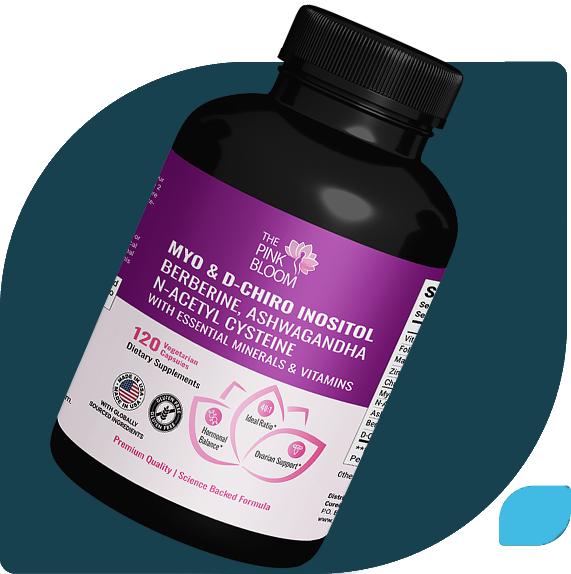
The Pink Bloom Formula: Why It Checks Every Box
So what does the best inositol supplement for PCOS actually look like in practice? Let’s walk through it.
The Pink Bloom’s myo-inositol formula was built around one principle: clinical alignment without compromise. Every decision – from the ratio to the capsule material – was made with the research in mind.
Here’s what’s inside, and why it matters:
2,000 mg Myo-Inositol + 50 mg D-Chiro-Inositol – The exact 40:1 ratio supported by clinical literature. Not approximate. Exact.
Berberine – A plant-derived compound with strong evidence for improving insulin sensitivity in PCOS. It works synergistically with inositol to support metabolic health and is one of the most studied natural compounds for best inositol for insulin resistance concerns.
Ashwagandha – An adaptogenic herb that helps regulate cortisol. Because stress and PCOS are deeply intertwined, addressing the HPA axis (your stress-response system) is part of a complete hormonal support strategy.
NAC (N-Acetyl Cysteine) – A powerful antioxidant that supports ovarian health and has been studied independently for its role in improving ovulation in PCOS.
Clean Label Project Certified – This isn’t a self-declared claim. It’s a third-party verification that the formula is free from heavy metals, pesticides, and harmful contaminants.
cGMP Manufactured – Current Good Manufacturing Practice standards mean every batch is produced under strict quality controls.
100% Vegan – Plant-based capsules, no animal-derived ingredients, no hidden dairy or gelatin.
Whether you’re looking for a myo-inositol supplement to support cycle regularity, exploring inositol for PCOS for the first time, or searching for comprehensive hormonal balance supplements that go beyond a single ingredient – the formula matters. Every single component should earn its place on that label.
Frequently Asked Questions
What is the best inositol brand for PCOS?
The best inositol brand is one that uses the 40:1 ratio of myo-inositol to D-chiro-inositol, provides clinically referenced dosages (2,000 mg myo + 50 mg D-chiro per serving), and holds third-party certifications like Clean Label Project. Transparency about ingredients and manufacturing standards is what separates a trustworthy brand from a marketing exercise.
What is the best inositol supplement for fertility?
The best myo-inositol supplement for fertility is one that uses the 40:1 ratio and is taken consistently for at least three to six months. Research shows that ovulation restoration and improvements in egg quality are most significant with sustained supplementation. Formulas that pair inositol with NAC and antioxidant support offer an additional layer of ovarian health support.
Is inositol powder better than capsules?
Both forms can be effective – what matters most is the ratio and dose, not the delivery format. Powder can be easier to take in higher doses and may absorb slightly faster, while capsules are more convenient and portable. The best inositol powder or capsule is the one you’ll actually take consistently every day.
What is the best form of inositol for PCOS?
Myo-inositol is the primary form your ovaries use, and it’s the best-studied form for PCOS. D-chiro-inositol plays a supporting role in insulin signaling. Neither works as well alone as they do together in the 40:1 ratio. So the best form of inositol for PCOS is the combination – not one or the other in isolation.
What is the best myo-inositol for insulin resistance?
For insulin resistance specifically, look for a formula that combines myo-inositol at the 40:1 ratio with metabolic support ingredients like Berberine. Berberine has been shown to activate AMPK – an enzyme that improves cellular insulin sensitivity – making it a powerful complement to inositol’s mechanism of action. Together, they address insulin resistance from two different angles.
Which inositol is best for women with PCOS who are just starting out?
If you’re new to inositol, start with a capsule-based formula at the 40:1 ratio and the standard dose (2,000 mg myo + 50 mg D-chiro per serving, twice daily). Take it with meals to minimize any GI adjustment. Give it a full 90 days before evaluating. And remember – this is a long game. Hormonal balance doesn’t happen in a week, but it absolutely can happen.


Leave a comment